For schools and universities in Sri Lanka aiming to spark curiosity about the cosmos, reflector telescopes remain essential tools. Their affordability, optical clarity, and versatility make them perfect for classrooms, science labs, and observatories. At ColperLab, we focus on curating telescopes that transform abstract lessons into vivid, hands-on experiences for students, giving them the thrill of observing distant worlds and deep sky phenomena firsthand. In Sri Lankan classrooms, school astronomy telescope choices that balance cost and performance help more students get time on the eyepiece.
Table of Contents
Understanding Reflector Telescopes
Newtonian reflector telescope designs rely on mirrors to gather and focus light instead of lenses. This design reduces chromatic aberration, producing sharper images of planets, stars, and galaxies. Unlike refractor telescopes, which bend light through lenses, reflector telescopes collect light using a primary concave mirror and redirect it to the eyepiece via a secondary mirror.
The benefits for educational settings are clear:
- Deep sky observation: The mirror-based design delivers crisp images that reveal intricate details of celestial bodies.
- Affordable telescopes for education: Large apertures are more cost-effective than equivalent refractors, allowing students to explore fainter objects.
- Hands-on engagement: Students can experiment with alignment, optics, and observation techniques, turning theory into practice.
Many educators find that even brief observational sessions with a telescope for students dramatically increase interest in astronomy and physics.
Selecting the Right Size for a School Lab
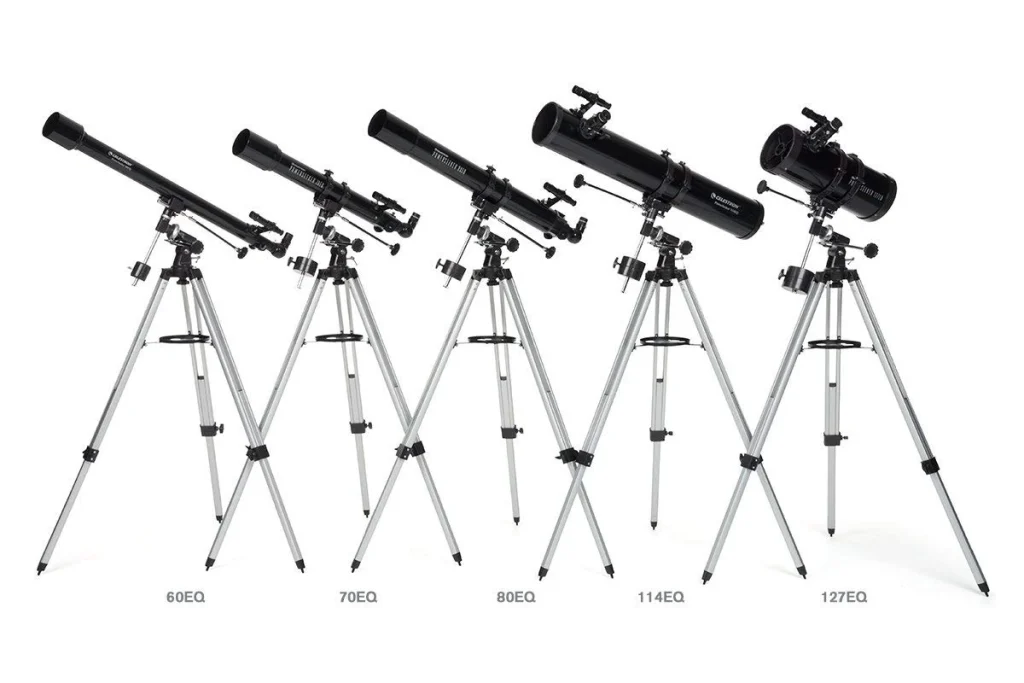
Choosing the right telescope aperture sizes is critical. The aperture determines how much light a telescope can collect, affecting what students can observe. A larger aperture captures dimmer objects but can be heavier and harder to store.
Small Classrooms: A 4–6 inch aperture reflector is ideal for compact settings. These reflector telescopes excel at observing the Moon and planets, providing clear views without overwhelming students. Their lightweight, portable design simplifies storage, ensuring that limited space doesn’t limit learning.
Medium Labs: For medium-sized labs, an 8–10 inch aperture classroom telescope strikes a balance between portability and deeper sky exploration. These models allow students to observe faint star clusters and nebulae while remaining manageable for regular use. Evening observation sessions are particularly effective, letting students engage with celestial phenomena directly.
Dedicated Observatories: Larger 12–16 inch apertures are perfect for dedicated spaces. These reflector telescopes enable detailed study of deep sky objects and are compatible with astrophotography for schools. Students can capture faint galaxies, nebulae, and star clusters, opening the door to more advanced projects and research-level exploration.
Short-term lessons benefit from smaller models, while larger reflectors expand possibilities for long-term study, public events, and extracurricular programs. Many Sri Lankan schools find that a mixed setup maximises both accessibility and depth.
Enhancing Learning Through Observation
Observation is where reflector telescopes shine. They are not just tools for stargazing—they foster scientific thinking, patience, and curiosity. Through regular sessions, students develop practical skills:
- Tracking celestial objects and recording data
- Comparing observations with star charts or online databases
- Understanding light behaviour, reflection, and telescope optics
Observation sessions often spark spontaneous questions about astrophysics, planetary motion, and light properties. Students begin to connect theory from textbooks to what they see in real time. For complementary daytime studies, explore the role of digital monoculars in field observation.
Exploring faint star clusters and nebulae introduces students to techniques used in professional astronomy, preparing them for advanced projects or research.
Practical Setup and Maintenance for reflector telescopes
Telescope maintenance is manageable in a school setting with consistent routines. Covering the telescope when not in use prevents dust and moisture from affecting the mirrors. Alignment checks, known as telescope collimation, keep images sharp. Just as important is safe handling—teaching students how to carry and adjust a telescope without touching the mirrors extends its lifespan. For care tips that also apply to related optics, see proper care and binocular maintenance.
Even minor misalignments can compromise the viewing experience. Short, regular maintenance routines are easier to manage than occasional long sessions and ensure the equipment is always ready for classroom or evening use. A mix of smaller portable units and larger lab instruments helps balance frequent access with protecting delicate gear.
Integrating Reflector Telescopes into Curriculum
Astronomy lab equipment like reflector telescopes fits seamlessly into multiple disciplines.
Astronomy Modules: Observing planets, moons, and star clusters turns abstract lessons into something tangible. Students connect diagrams and theories from textbooks with real celestial objects. For comparisons across optical tools, students can review zoom vs fixed binoculars for field studies.
Physics Lessons: Reflector telescopes provide a direct way to demonstrate optics, reflection, and magnification. Instead of learning these ideas in isolation, students see how they function hands-on.
Data Projects: Charting lunar phases, tracking planetary movement, or observing variable stars encourages students to gather and analyse data. These projects build patience and attention to detail while reinforcing scientific methods.
Observation-based work helps students bridge theory and practice. Measuring the apparent brightness of stars over several nights introduces concepts like stellar magnitude and light travel.
Future-Proofing School Astronomy Labs with reflector telescopes
Reflector telescopes remain relevant because of their adaptability. Modern models integrate with digital cameras, sensors, and tracking software, allowing real-time imaging and extended observation. Schools can capture and store images of deep sky objects or conduct basic photometry without investing in professional observatories.
Projects involving faint targets often lead students to experiment with astronomy lab equipment add-ons, nurturing future scientific interests. This adaptability ensures that even smaller programmes keep pace with technology.
Opening Windows to the Universe
Investing in reflector telescopes goes beyond equipping labs—it nurtures curiosity, analytical thinking, and a lifelong fascination with science. Properly chosen, maintained, and integrated into school programmes, these instruments provide students with direct encounters with the universe.
At ColperLab, we curate reflector telescopes and accessories that make astronomy accessible for educational institutions across Sri Lanka, turning every observation into a lesson in discovery. They do more than show planets—they illuminate potential, curiosity, and wonder in every student willing to look up.
